Home of inspirational, thoughtful, interesting medicine.
Neurologic Examination of the Limbs
Tone
Reading time: 10 minutes
Neurologic examination is an art as much as a science. Although most students find it difficult to wrap their heads around, it is actually really simple once you understand the rationale behind it. Doing so, will enable you, to not only perform the examination but also interpret the findings with ease. This blog is the first in a series that explains the rationale behind the examination.
While reading these blogs remember that every step in the examination is followed by another step that either confirms or refutes what you have just inferred from the previous step. In other words, examination and interpretation are happening simultaneously. Think of it as a treasure hunt, where the outcome of the previous step helps you decide which way to go next.
How to do a neurological examination of the limbs?
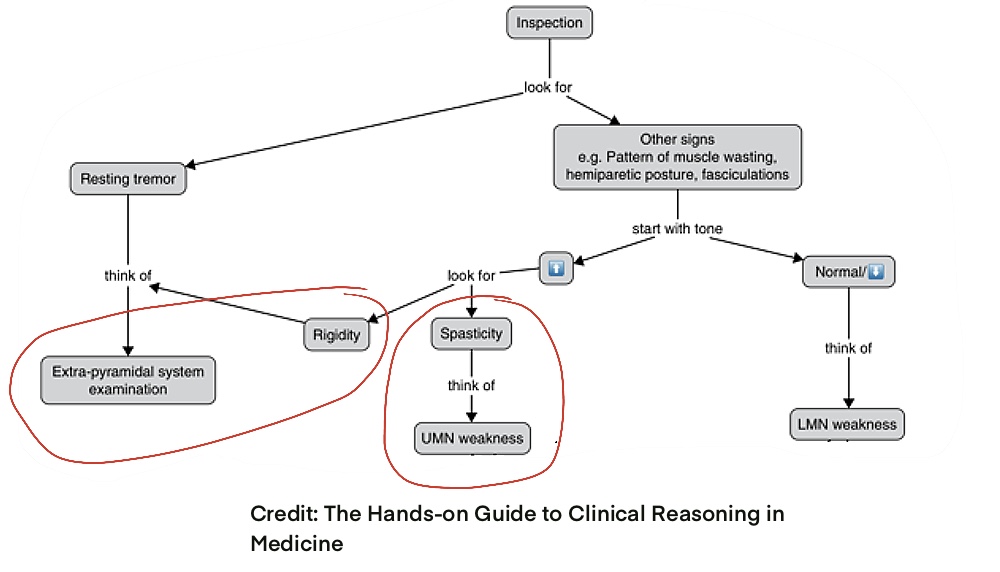
Interpretation of the limb examination starts the moment you lay your eyes on the patient. It consists of assessment of the gait, looking for the pattern of weakness or muscle wasting and fasciculations. You then start with assessment of the tone. An important component of this is ascertaining whether someone has spasticity or rigidity.
Spasticity versus Rigidity
The importance of distinguishing between them lies in the fact that spasticity takes you down the corticospinal pathway (upper motor neuron – UMN) and rigidity the extrapyramidal system as shown in figure 1.
Hold the patient’s hand as if you are going for a hand-shake and passively supinate the wrist from a prone position. Do this both slowly and then really quickly.
Now, if you move the wrist slowly and feel no resistance but when you do it ‘quickly’ it catches mid-way, it is called the supinator-catch implying spasticity. On the other hand, if there is resistance throughout the range of movement whether you do it slowly or quickly, it is called rigidity. In other words you decide whether the increased resistance is velocity dependent or not. See figure 2 for a few more differences between the two.
p.s. Rigidity can be accentuated by asking the patient to tap the other hand on their thigh.
Figure 2
Rigidity versus spasticity
Neurologic examination of the lower extremity
In the lower limbs, it is a bit more involved. What we do is lie the patient down, asking them to relax their legs (easier said than done!). Distracting them with a conversation, is a useful method to achieve this. We then roll their leg at the level of the knee while watching how floppy their foot moves with this manoeuvre. If the foot moves en bloc with the leg – the tone is increased (figure 3). On the other hand, if the foot remains floppy as you roll the leg, the tone is normal or reduced. Although, the latter is very subjective, hence I personally wouldn’t like to draw this inference.
Figure 3
Lower Limb Tone
Immediately after this manoeuvre, you put your hands behind the knee and lift it suddenly off the bed, while watching what the ipsilateral (same-sided) heel does. If it gets lifted off the bed, it confirms the lower limb equivalent of the supinator catch i.e. spasticity (figure 4). If it scrapes the bed then the tone is normal.
Figure 4
Lower Limb Spasticity
Click the link here to watch a good summary of what we have been talking about so far (Fearon et al. 2015).
Upper motor neuron lesion versus lower motor neuron lesion
Hypertonia points to an upper motor neuron lesion while a normal or reduced tone in the presence of weakness points to a lower motor neuron lesion. Hypertonia can be further confirmed with clonus at the knee or the ankle. In the next blog I will talk about this and how it helps cement what you have detected so far!
Sign up to receive notifications when this gets uploaded.
Bridgwood, B. 2020. Books: The Hands-on Guide to Clinical Reasoning in Medicine: Developing Clinical Reasoning. The British journal of general practice : the journal of the Royal College of General Practitioners 70(696), p. 350. Available at: https://doi.org/10.3399/bjgp20X710597 [Accessed: 6 May 2021].
Fearon, C. et al. 2015. How Do I Examine Rigidity and Spasticity? Movement Disorders Clinical Practice 2(2), p. 204. Available at: /pmc/articles/PMC6183506/ [Accessed: 5 May 2021].
Subscribe to the blog in order to receive notifications when new blogs are uploaded. Feel free to explore the website.
Subscribe to Blog via Email
Join 56 other subscribers
1 thought on “Neurologic Examination of the Limbs”



1 thought on “Neurologic Examination of the Limbs”
Pingback: Upper Motor Neuron Weakness - Patterns in Neurologic Exam -